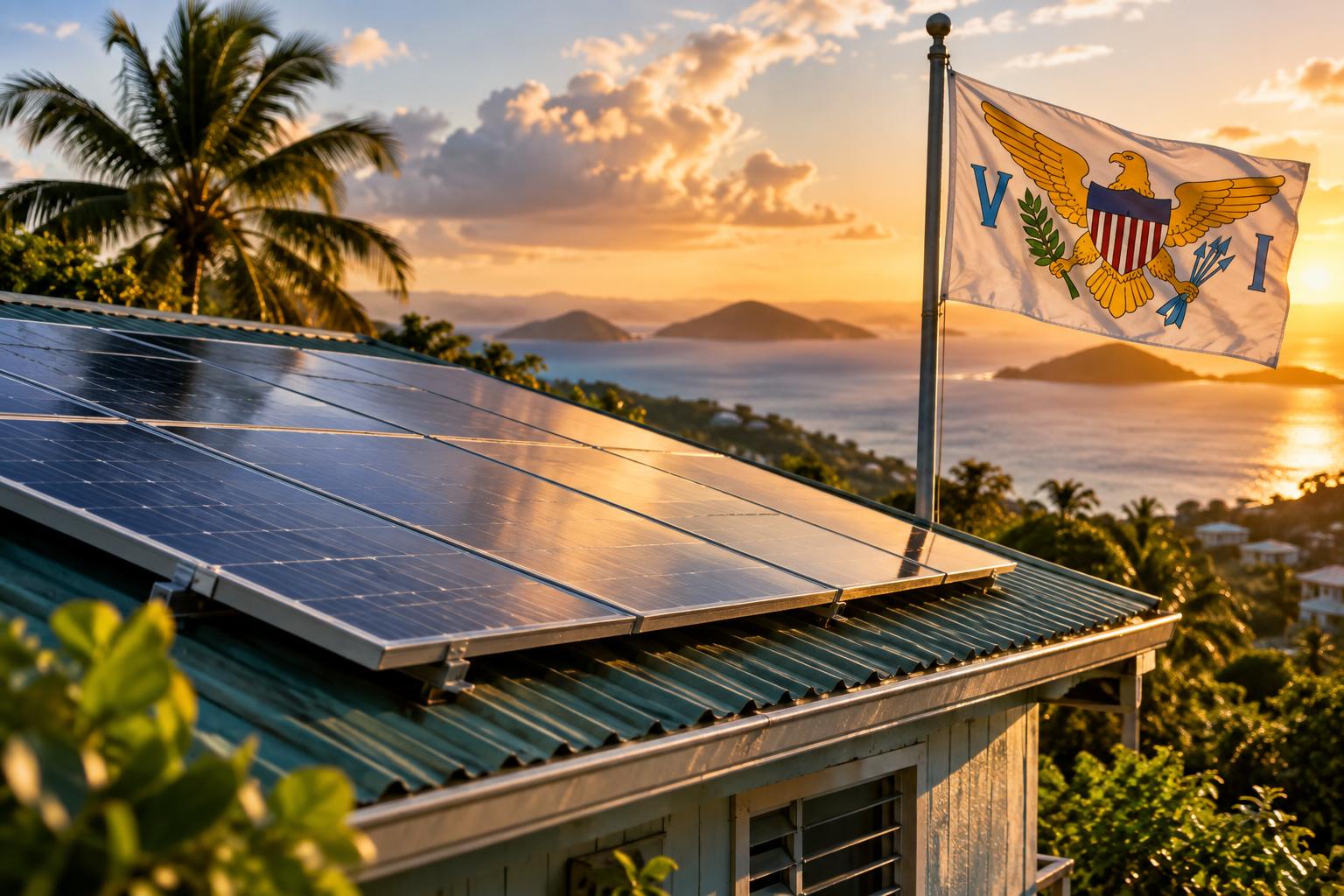
Farmers and rural small businesses across the Virgin Islands will face a fundamental change in how they pursue federal funding for renewable energy and energy-efficiency projects under revised U.S. Department of Agriculture rules effective October 16.
The overhaul of the Rural Energy for America Program, or REAP, reverses the traditional application sequence. Instead of applying before construction begins, businesses must now complete their projects, operate them for a full year, and submit documentation of actual energy production or savings as part of their grant request.
Under the new framework, applicants must provide 12 months of verified energy data alongside pre-installation measurements. The USDA will then assess eligibility, financial risk and competitive standing. Meeting all requirements and finishing a project does not guarantee funding.
Projects generally need to be finished between 12 and 24 months before an application is submitted. For the first application cycle, the agency is allowing a broader window: projects may be completed between 12 and 36 months prior, provided the construction period itself does not exceed 24 months.
The shift creates an upfront financing hurdle. Applicants must secure their own money to pay for work before knowing if a grant will materialise. USDA has pointed to its Guaranteed Loan Program as one option, though that requires borrowing from a lender with interest and repayment terms. Combined grant and loan support cannot exceed 75 percent of total project cost.
Grants now demand that applicants cover at least 75 percent of expenses themselves, capping the federal share at 25 percent. Minimum grant requests are $1,500, with ceilings of $500,000 for renewable energy and $250,000 for efficiency upgrades.
Three Virgin Islands projects received REAP support in early 2025. Beeston Hill Health and Wellness LLC on St. Croix obtained $21,180, Sister Twister Frozen D'Lite on St. Thomas received $32,010, and Calidad Construction and Maintenance LLC on St. Croix was awarded $225,000, all for solar installations.
To qualify, businesses must be agricultural producers or rural small businesses operating for at least 12 months before their project begins. Projects must sit in rural areas, generally excluding cities or towns exceeding 50,000 residents.
Solar and wind systems with components from countries designated as foreign adversaries are ineligible, though projects installed before October 1 are exempt from that restriction. Ground-mounted solar on cropland and wind turbines on farmland are not allowed, as are projects at multiple sites.
As of early October, USDA's website indicated that REAP grant applications were not being accepted, though guaranteed-loan applications remained available. The agency will issue a separate funding notice with application procedures and competition details.

Comments
No comments yet. Be the first.