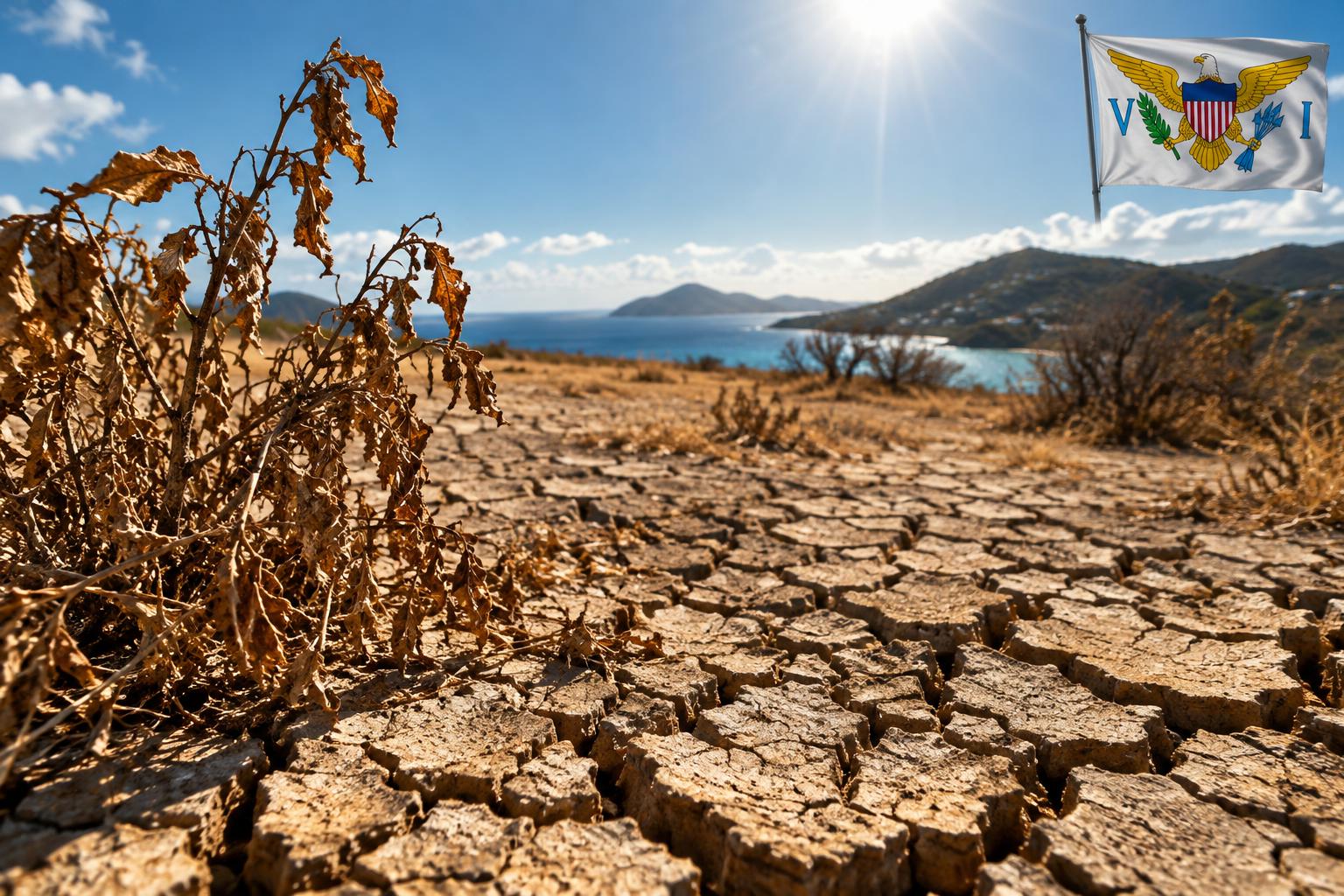
St. Thomas has slipped into Exceptional Drought, the most severe tier on the federal drought scale, according to an October 8 assessment from the National Oceanic and Atmospheric Administration. St. Croix and St. John remain one level below, classified as Extreme Drought. The shift represents a worsening from July, when all three islands held the same Extreme Drought status.
The deterioration has hit farmers hard. Livestock producers are culling herds and separating animals to slow reproduction as feed and water grow scarce. Poultry farmers report abnormally early molting tied to intense heat. Orchard operators say fruit trees are dying, with avocados undersized and some coconut and banana trees lost entirely. Mango and dragon fruit trees continue bearing fruit, but the overall picture remains bleak.
Conditions vary by island. On St. Thomas, agricultural ponds have emptied or nearly emptied, and soil has dried to depths that make planting impractical. Bordeaux recorded just 1.89 inches of rain over the summer, roughly one-fifth of the normal amount. St. John faces cracked earth, fallen banana plants and withered row crops and fruit trees. Many ponds there have vanished entirely. St. Croix has received scattered showers, including remnants from Tropical Storm Dolly in late August, but not enough to reverse the drought. Farmers report losses of sheep, goats and cattle, with soil cracks reaching 24 inches deep in some areas.
The financial strain is mounting. Water deliveries of 5,000 gallons cost around $450, while hay runs $30 to $35 per bale. The Virgin Islands Department of Agriculture cannot provide baling services in the St. Thomas-St. John District due to equipment shortages, making it harder for farmers to find affordable feed.
Wildlife is also suffering. Deer and birds are moving closer to homes seeking food and water. Wild poultry numbers are declining. Federal officials warn that dry vegetation and wind are raising wildfire risk.
The broader water system is stretched thin. Groundwater levels remain low and cannot recover without substantial rain. The territory produces roughly 3.1 million gallons of water daily through desalination while consuming about 3 million gallons, leaving almost no cushion for error.
In August, Governor Albert Bryan Jr. sought federal disaster aid. The U.S. Department of Agriculture approved a Secretarial Drought Disaster Declaration on August 20, opening all three islands to emergency loans for farmers through the USDA Farm Service Agency. Applicants have eight months from that date to apply.
Relief looks distant. Federal forecasters project 50 to 60 percent odds of below-normal rainfall through early winter, with above-normal temperatures 70 percent likely. El Niño is expected to strengthen through the end of 2026, with roughly 90 percent probability of a very strong event during fall and winter 2026-2027. Strong El Niño episodes typically bring below-normal rainfall to the northeastern Caribbean. The National Oceanic and Atmospheric Administration's Seasonal Drought Outlook predicts drought will persist through December, with conditions possibly approaching normal only in late winter and early spring 2027.


Comments
No comments yet. Be the first.