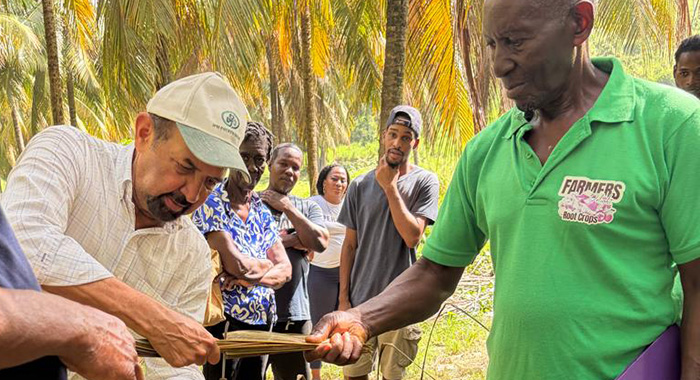
A United Nations agricultural agency has finished a technical training programme in St. Vincent and the Grenadines designed to strengthen coconut farming and processing across the island's supply chain.
The seven-day mission, run jointly by the Food and Agriculture Organization and the Ministry of Agriculture, reached 87 participants across two farming zones. The windward cluster in Orange Hill hosted 43 farmers and technicians, while the leeward cluster in Barrouallie brought together 30 ministry staff and farmers. A separate community session on August 29 involved 14 members from grassroots organisations including Helen's Daughters, Eco-home Garden Limited, and Rejoin Fruit and Farm.
FAO specialist Abel Rebouças Sao Jose, who leads the agency's fruit tree crop work, directed the sessions using methods proven in Brazil and the Dominican Republic. Participants studied soil conditions, plant varieties, seedling production, orchard setup, plant nutrition, and pest management, with hands-on field work included.
Rebouças highlighted obstacles to expanding output. "Several challenges still need to be addressed to increase St. Vincent and the Grenadines' coconut production," he said. He pointed out that both expanding farmland through profitable schemes and lifting yields on current plots were necessary. "That means selecting high-yielding varieties, establishing nurseries that produce seedlings of good genetic and phytosanitary quality, and adopting good cultivation practices. Improving yields alone could meaningfully increase total coconut production," he added.
Sophia Searles, a local coconut processor, spoke to farmers about commercial possibilities beyond raw material sales. "As manufacturers expand into value-added products, they need a consistent supply of quality raw material, and farmers have a real chance to become part of that growing value chain," Searles said.
The programme also included instruction on soursop farming, drawing on FAO experience in Belize and Grenada.
The work sits within the Coconut Value Chain Pilot Programme, which identified coconut as a high-priority crop with room for processing and market growth. A replanting scheme run with the Caribbean Agricultural Research and Development Institute will run through November 2026, using the improved plant types and methods taught during the mission.


Comments
No comments yet. Be the first.