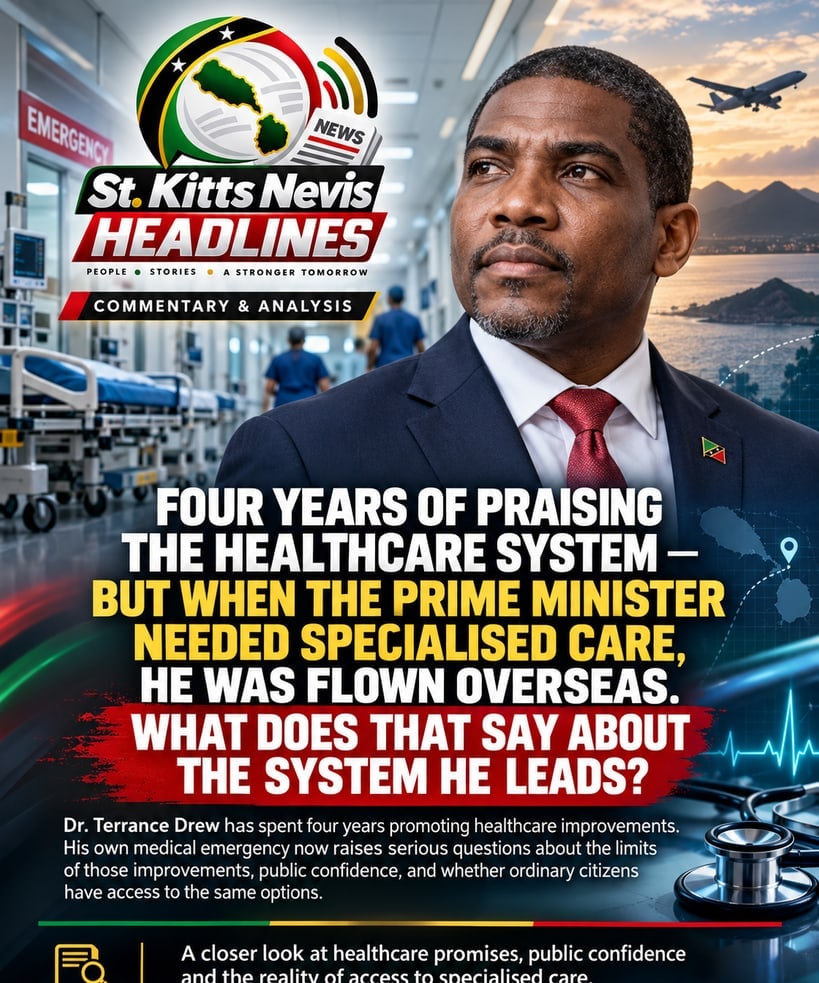
On August 30, 2026, Prime Minister and Minister of Health Dr. Terrance Drew suffered a medical emergency and received initial treatment at the Joseph N. France General Hospital. Medical staff there determined that overseas specialist care was necessary, and he was airlifted first to Martinique, then to Miami. The government confirmed that his doctors made the recommendation for transfer.
The incident has reopened debate about the healthcare system's true capabilities. For the past four years, Dr. Drew's administration has positioned medical improvements as a cornerstone of its record. An official government publication in April 2025 called these efforts among the most transformative in the Federation's modern history. The messaging has consistently highlighted a new CT scanner, expanded specialist services, additional dialysis capacity, hospital renovations and better emergency transport.
Yet the Prime Minister's need to leave the country for treatment raises uncomfortable questions about what remains unavailable locally. Commentary published on the situation notes that while seeking appropriate care is entirely reasonable, Dr. Drew's dual role as both patient and healthcare minister creates accountability concerns. The analysis asks: when ordinary citizens face comparable medical crises, can they access overseas transfer as readily? Who decides eligibility? Who covers the cost? What standards apply?
Government investments in equipment and infrastructure are real and measurable. However, new facilities do not automatically translate into the ability to handle every serious emergency. A modernised hospital is not necessarily one equipped for every specialist intervention.
The episode has prompted calls for the government to publish concrete data: emergency response times, specialist availability, patient transfer protocols, treatment delays, staffing numbers and clinical outcomes. There are also questions about whether a clear, transparent system exists for citizens needing specialist care abroad, what government support is available, and whether such arrangements are adequately funded.
Dr. Drew has previously cited falling in-hospital death rates as evidence of progress, most recently in July 2026. Observers argue these claims should be tested against independently verified results rather than accepted as political announcements. The public debate, analysts say, should focus on measurable improvements, remaining gaps, the overseas referral process, and whether access to necessary care depends on clinical need rather than financial resources or official position.




Comments
No comments yet. Be the first.