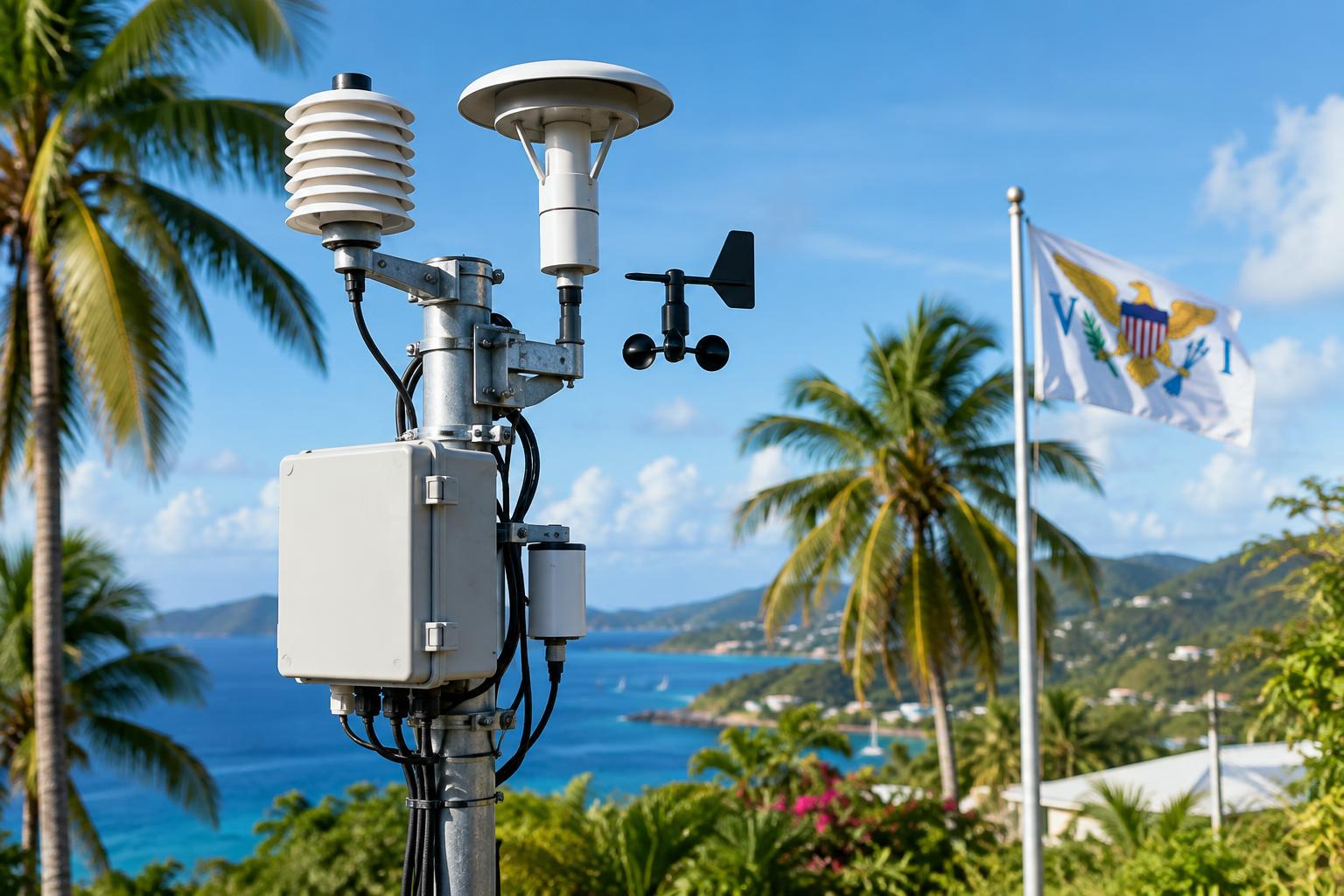
The U.S. Environmental Protection Agency has proposed designating the U.S. Virgin Islands as meeting federal air-quality benchmarks for fine-particle pollution, diverging from what territorial authorities had requested.
In a letter dated September 30, 2026, EPA Region 2 Administrator Michael R. Martucci informed Governor Albert Bryan Jr. of the agency's intention to classify the territory as "attainment/unclassifiable" under a tightened annual standard for PM2.5, the microscopic particles and liquid droplets that pose health risks when inhaled.
The Department of Planning and Natural Resources had recommended instead that the territory receive an "unclassifiable" designation alone, arguing in January 2025 that monitoring data from the Virgin Islands' PM2.5 network was too sparse to support any firm conclusion.
Under EPA terminology, attainment indicates compliance with air standards, while unclassifiable signals insufficient data for a determination. The combined category the EPA proposes applies to places that meet the standard and do not worsen pollution in neighbouring areas.
The EPA strengthened its annual PM2.5 benchmark in 2024, lowering the threshold to 9 micrograms per cubic meter from the previous 12. Compliance relies on three-year average readings. According to the agency's preliminary assessment, no monitors recorded levels breaching the updated standard, though the letter's supporting documents list monitoring fields as "N/A" and contain no actual numerical results for the territory.
PM2.5 particles, roughly one-thirtieth the width of a human hair, penetrate deep into lung tissue and can cross into the bloodstream. The EPA attributes exposure to worsened asthma, diminished lung capacity, cardiac events and early death among people with existing heart or lung disease. Children, the elderly and those with chronic respiratory or cardiovascular conditions face heightened vulnerability.
Sources include power plants, diesel generators, vehicle exhaust, shipping, industrial facilities and refineries. Wildfires and burning of wood or vegetation release these particles. Construction, unpaved roads and soil disturbance contribute fine dust, though larger particles fall into separate categories. Gases such as sulfur dioxide and nitrogen oxides from combustion undergo chemical transformation in the atmosphere, forming additional fine particles downwind.
The territory has until November 1, 2026, to submit supplementary information. A public-comment period will follow Federal Register publication. The EPA is working under a July 17, 2026 court order mandating final designations by February 6, 2027, though the agency is contesting that order.


Comments
No comments yet. Be the first.