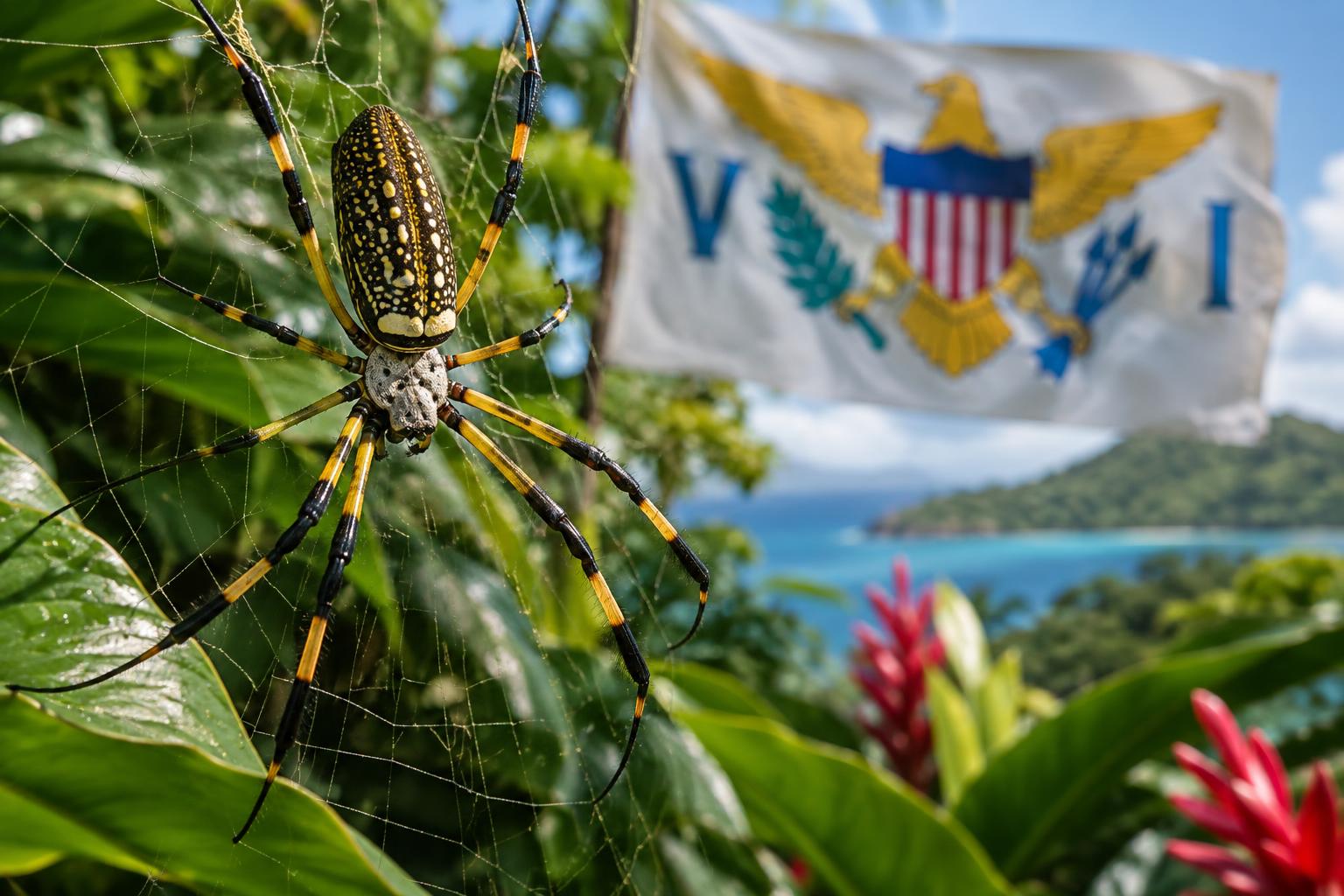
A spider species previously absent from the scientific record of the US Virgin Islands has been identified through photographs submitted by residents, the US Department of Agriculture's Forest Service announced on Friday, October 9.
The discovery emerged from a broader research effort examining how public contributions can advance Caribbean biodiversity documentation. Entomologist Javier E. Mercado led the work, which identified 13 spider types never before recorded in scientific literature across the US Virgin Islands and Puerto Rico combined.
The Virgin Islands specimen, resembling members of the genus Ummidia, appeared in photographs taken on St. John in 2022 and again on St. Thomas in 2023. A St. Thomas image uploaded to the citizen science platform iNaturalist by Scott Hardage proved instrumental in the identification process.
Mercado analysed the submitted images and found physical characteristics matching the family Halonoproctidae. He noted, however, that actual specimens would be required to definitively establish whether these spiders belong to Ummidia or represent an undescribed genus within that family.
The research, published in the Caribbean Journal of Science in 2025, drew primarily on observations from Puerto Rico, where citizen photographers documented spiders across roughly two decades. The Virgin Islands contributed one of the 13 newly documented types. Among the 13 findings, six were identified to species level, six to genus, and one to family.
Mercado compiled data from iNaturalist submissions, two Puerto Rico-based nature observation groups, his own records, and photographs from other contributors. His analysis revealed that citizen observations identified 13 previously unrecorded spider types over approximately 20 years, surpassing the eight types documented by professional arachnologists in the same period.
The research also expanded the regional scientific record to include three spider families not previously documented in the area: Halonoproctidae, Cithaeronidae and Symphytognathidae.
Mercado determined that public photographs could help address a significant constraint: the small number of specialists working on Caribbean spiders. The Forest Service noted that this approach enables faster detection of spider population changes at reduced cost while enriching the region's biodiversity documentation.
The agency also underscored potential applications to mosquito research and disease transmission, as spiders naturally prey on insects including mosquitoes. Mercado's study did not, however, measure whether the newly documented spiders reduce dengue transmission or assess their effectiveness in controlling mosquito populations.



Comments
No comments yet. Be the first.