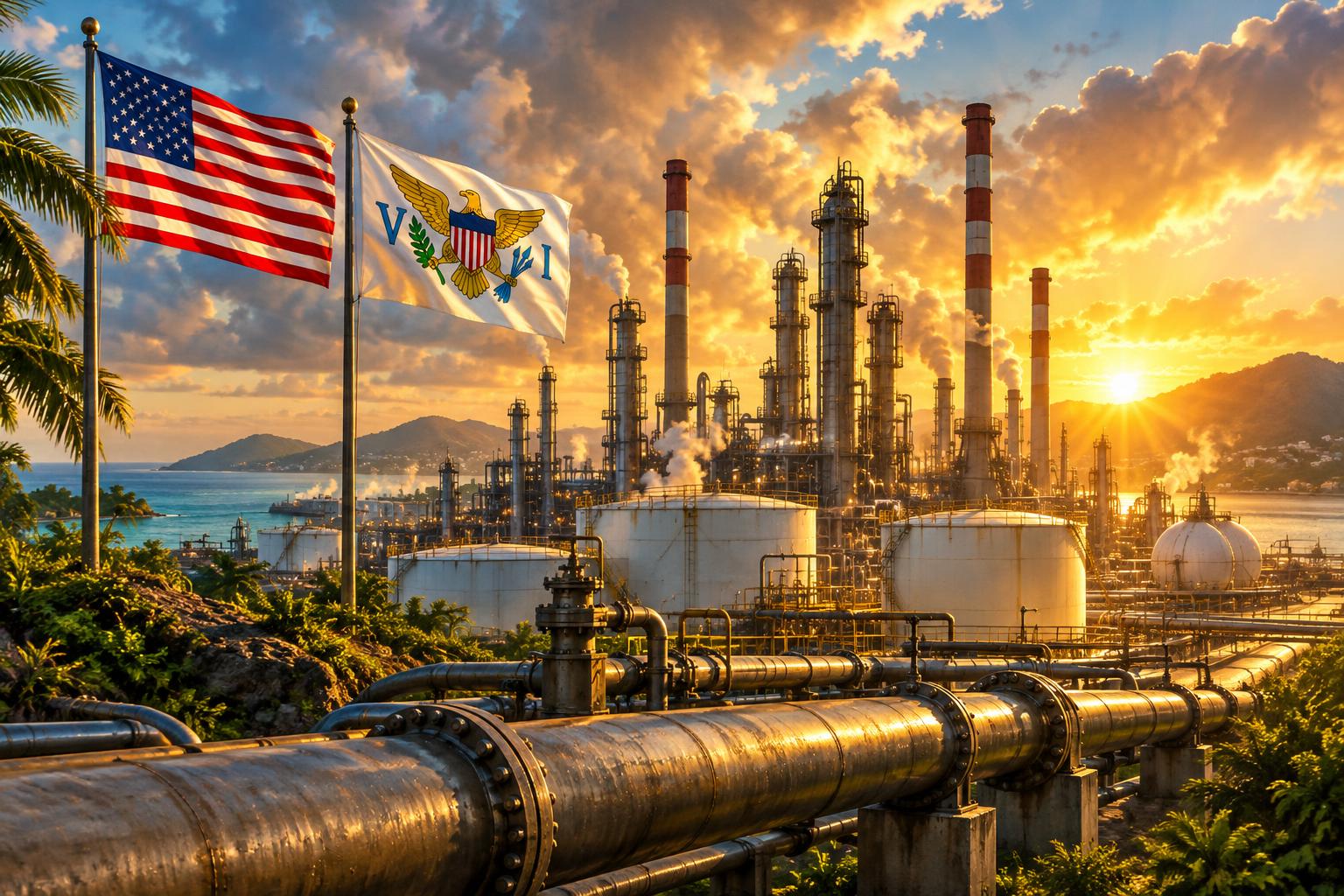
Governor Albert Bryan Jr. has called on the Trump administration to treat St. Croix's shuttered oil refinery as a strategic national asset and create a coordinated federal plan to restart operations.
In an opinion piece published by the Washington Examiner, Bryan argued that the existing industrial infrastructure on the island could help expand U.S. refining capacity at a time when the White House is pursuing access to Venezuelan crude oil. The administration recently announced an agreement giving the U.S. government control over more than 65 billion barrels of proven Venezuelan reserves.
Bryan noted that building a new refinery from scratch would take years and require extensive financing and permitting. The St. Croix facility, by contrast, retains much of its original processing equipment and infrastructure. The former Hess refinery, built in 1966, once processed more than 650,000 barrels per day and was the world's largest refinery in the 1970s. A 2021 restart attempt operated at roughly 200,000 barrels per day before halting. Federal data show the territory currently has zero operable refinery capacity as of January 2026, down from 180,000 barrels per stream day in 2021.
The governor emphasized the facility's geographic advantage for processing heavy crude from Venezuela and Guyana, and highlighted potential economic benefits including skilled jobs, contractor work and government revenue for schools and infrastructure.
Bryan acknowledged the refinery's troubled environmental history. The EPA used emergency powers in May 2021 to shut down the Limetree Bay operation after pollution incidents and oil releases, citing risks to public health. However, the regulatory landscape has shifted. A federal appeals court in 2023 ruled that EPA lacked authority to require new permits simply for restarting an existing plant, and EPA abandoned its broader reactivation policy in 2025.
Port Hamilton Refining and Transportation, which owns the facility, stated in May that it envisioned an initial restart configuration of approximately 220,000 barrels per day.
Bryan stopped short of requesting environmental waivers or federal investment guarantees. Instead, he called for the White House to convene a coordinated team including territorial officials, refinery operators and federal agencies responsible for energy, environment, territorial affairs and defence. The goal, he wrote, should be establishing clear requirements and determining what existing federal tools could support a qualified project.

Comments
No comments yet. Be the first.